The power and transience of beauty
Cartes Postales from GreeceThe power and transience of beauty shape the account of Costas Arvanitis and the buried Aphrodite statue, where aesthetic wonder becomes both a renewed source of life and a force he cannot safely master. The book treats beauty not as a stable possession but as an encounter: it can awaken desire after a long absence, command attention before understanding, and make mortality newly visible. Costas’s brief experience gives this idea its most intimate form; a later image at Delphi extends it into a meditation on lost youth and death.
The Statue and the Force of Beauty
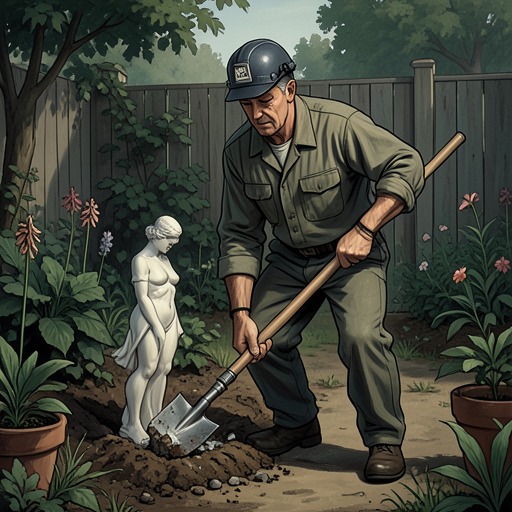
When the statue is finally exposed, Costas understands her as Aphrodite, though he does not know her name. The account links this recognition to the ancient sculptor’s conviction: craftsmen depicting the gods believed not only that an image represented a god, but that the god was present in it. Costas, in turn, experiences the power of that belief. The statue seems less like an archaeological object than a sleeping presence, waiting through millennia to be found and revived. Beauty here has an almost sacred authority, generated by the convergence of the statue’s form, its age, and the beholder’s conviction about what it represents.
The first view is incomplete. The statue lies face down, and Costas, absorbed by the discovery, waits until the following day to try to turn her. When he begins, he uses wooden planks and rope as levers, work that would ordinarily require several men. He chooses to do it alone because he does not want to share what he regards as his woman. His care is mixed with possessiveness: he fears that the fragile statue might break, yet insists on controlling the encounter himself. The scene makes the pull of beauty physical and practical before it becomes an explicit reflection on desire.
Costas’s Encounter and Its Cost
After several failed attempts, the improvised arrangement works briefly. As the statue rises, Costas catches only a glimpse of her profile: the outline of a strong nose, full lips, and an oval eye, with the sculptor’s faintly indicated smile at its corner. This fragment is enough for him to apprehend the face as flawless as the body. The moment is structured around partial sight: he does not gain possession of a complete view, but the glimpse intensifies rather than satisfies his curiosity.
As the statue falls face down again, the force of her beauty overwhelms him. Costas gasps, and the effort of lifting her is followed by breathlessness, chest tightness, and pain in his arms. He recognizes that he has over-exerted himself and lies beside the statue. His death follows the attempt to turn her. The episode therefore binds physical exertion and aesthetic surrender without treating them as the same thing: he knows he has strained himself, but the narrator also describes the statue’s erotic power as part of what makes this encounter so consuming. Costas’s response is not simply admiration from a safe distance; beauty has become an experience that alters his conduct and ends his life.
Desire, Aging, and Renewed Life
The narrator interprets Costas’s attachment through the Greek distinctions among agapi, filia, and erotas: broadly, love directed toward God and family, friendship, and sexual attraction. These categories overlap, but the distinction matters to Costas’s story. Erotas has been absent from his life for many years; for the few weeks shaped by the statue’s discovery, he feels its enriching power again. Beauty does not restore youth or undo the limits of his body. It does, however, give him a zest for life that the narrator believes he had lost. The meaning of the episode is therefore double: Costas dies, but the narrator imagines him as happy and fulfilled at the moment of death.
This account also places desire against the visible effects of aging. Reflecting on older people in mountain villages who have lost their teeth, their hair, or their interest in appearance, the narrator wonders what attraction remains between the sexes. The question is not answered by claiming that beauty lasts; instead, the reflection stresses how difficult it can be to understand attraction from outward appearance alone. The narrator considers the human appreciation of beauty innate, yet notes that few people possess it and that it lasts only briefly. Costas’s renewed desire makes beauty’s vitality palpable, while his death and the narrator’s thoughts on aging expose its limits.
Beauty as Warning and Memento Mori
The narrator does not dismiss Costas’s worship of the statue. The encounter teaches a distinction between appreciating beauty and being seduced by it: the latter can make people lose their judgment. Socrates’s image of beauty as a short-lived tyranny gives the episode a concise formulation. Beauty rules powerfully, but its rule is temporary; the phrase captures both the intensity of Costas’s response and the narrator’s resolve to be more cautious in future.
At Delphi, the image of Antinous supplies a related meditation. Supposedly the most handsome man in the world and beloved by Emperor Hadrian, Antinous drowned in the Nile; Hadrian, heartbroken, made him a demi-god. The statue is described as a lament for lost beauty and youth. Unlike Costas’s private encounter with Aphrodite, this image makes grief for beauty’s loss public and commemorative. Together, the episodes place beauty beside mortality rather than outside it: a statue can preserve an ideal form, and a story can remember the dead, but neither can prevent the loss that gives such images their pathos. The recurring contrast is not between beauty and death as opposites, but between beauty’s power to make life feel vivid and its inability to make that vividness permanent.